Best Tankless Water Heaters of 2026: The Complete Buyer's Guide
Affiliate Disclosure: TanklessGeek participates in the Amazon Services LLC Associates Program. We earn commissions from qualifying purchases through our Amazon links at no extra cost to you. We recommend products based on specifications, performance, and value, not commission rates.
Rinnai RU199iN - Best Gas Condensing
11 GPM, 0.96 UEF, 199K BTU, 12-year heat exchanger warranty. The deepest service network in the industry and a 50-year track record in North America.
Navien NPE-240A2 - Best Engineering
11.2 GPM, 0.97 UEF, built-in recirculation pump + ComfortFlow buffer tank. The only unit that solves cold water sandwich out of the box.
Rinnai RU180iN - Best for Most Homes
10 GPM, 0.93 UEF, 180K BTU, 15-year warranty. Hits the sweet spot of performance and price for 2-3 bathroom homes.
Stiebel Eltron Tempra 36 Plus - German Engineering
36 kW, 7 GPM, Advanced Flow Control, 7-year warranty. The gold standard for whole-house electric tankless.
Why This Guide Exists
A tankless water heater is a $2,500-$5,500 investment that should last 15-20 years. Get it right, and you'll save $150-$250 annually on energy bills while never running out of hot water. Get it wrong, and you'll deal with temperature swings, undersized flow, and a unit that can't keep up when two showers run simultaneously on a January morning.
The internet is full of surface-level roundups that recommend five models without explaining why any of them are right for your situation. Your climate, household size, existing gas infrastructure, and electrical panel capacity all matter. A unit that's perfect for a 2-bathroom home in Atlanta is wrong for a 4-bathroom home in Minneapolis.
We spent 160+ hours on this guide. We analyzed manufacturer specs, independent lab data, ENERGY STAR certifications, and 4,800+ verified owner reviews across Amazon and Home Depot. We looked at warranty claim patterns, real-world failure modes, and service network depth. The eight units on this list represent the best in each category - and this guide tells you exactly which one matches your situation.
If you already know what you need, jump to our Quick Picks. If you want help figuring out what you need, start with our Decision Tree or the BTU/GPM Calculator below.
Which Tankless Water Heater Is Right for You?
Answer 3-4 questions and we'll recommend a specific model. Takes 30 seconds.
Our Recommendation
For a small home on gas with value as the priority, the Rheem RTGH-95DVLN at $950-$1,100 gives you 9.5 GPM - plenty for 1-2 bathrooms. Non-condensing design means simpler maintenance and potentially lower installation cost if you have an existing flue.
Read Full Review → Check Price →Our Recommendation
For a smaller home where you want the best technology, the RU180iN gives you condensing efficiency (0.93 UEF), 10 GPM, and Rinnai's 15-year heat exchanger warranty. More unit than you need for 1-2 baths, but the efficiency savings and warranty make it the better long-term buy.
Read Full Review → Check Price →Our Recommendation
Even in a small home, if you want zero cold water surprises, the Navien's built-in recirculation pump and buffer tank are worth the premium. You'll have instant hot water at every tap and the highest efficiency rating (0.97 UEF) of any gas unit.
Read Full Review → Check Price →Our Recommendation
The sweet spot for most American homes. 10 GPM handles 2-3 bathrooms with room to spare. Condensing efficiency at 0.93 UEF saves $130-$180/year vs. a standard tank. 15-year heat exchanger warranty and Rinnai's unmatched service network make this the smart default choice.
Read Full Review → Check Price →Our Recommendation
If you want the best available for a medium home, the RU199iN's 11 GPM and 199K BTU give you headroom for cold-climate performance drops and future bathroom additions. 0.96 UEF and a 12-year heat exchanger warranty. The industry benchmark.
Read Full Review → Check Price →Our Recommendation
Built-in ComfortFlow recirculation eliminates the cold water sandwich that plagues every other tankless unit. 0.97 UEF is best-in-class. 15-year heat exchanger warranty. If instant hot water matters to you, this is the only unit that delivers it without add-ons.
Read Full Review → Check Price →Our Recommendation
For a large home on a budget, the RU199iN is the minimum you should consider. 11 GPM and 199K BTU handle 4+ simultaneous fixtures. At $1,000-$1,300, it's not cheap - but undersizing a large home costs more in frustration and cold showers than the extra $200-$300 upfront.
Read Full Review → Check Price →Our Recommendation
For large homes that need commercial-grade durability, the Takagi T-H3-DV-N's HRS35 copper alloy heat exchanger is built for heavier usage patterns. 10 GPM, 199K BTU, and it can easy-link up to 4 units for truly massive demand. Popular with contractors who install in restaurants and salons.
Read Full Review → Check Price →Our Recommendation
For a large home where comfort is paramount, the Navien's recirculation system truly shines - in a 4+ bathroom home, the distance from heater to far fixtures makes cold water sandwich much more noticeable. The NPE-240A2 eliminates it entirely. 11.2 GPM, 0.97 UEF, 15-year warranty.
Read Full Review → Check Price →Our Recommendation
In warm climates where groundwater stays above 60°F, the ECO 27 delivers 6+ GPM at a fraction of the cost. Lifetime warranty. Self-modulating technology. At $290-$390, it's the best value in electric tankless - but only in warm climates. Northern buyers, step up to the Stiebel Eltron.
Read Full Review →Our Recommendation
In moderate climates, you need the extra 9 kW the Tempra 36 Plus has over the EcoSmart. Advanced Flow Control prevents cold water delivery. 7 GPM at a 50°F rise covers one shower plus a sink. German engineering, 7-year warranty, silent operation.
Read Full Review → Check Price →Our Recommendation
The Tempra 36 Plus is the best electric option for cold climates, but be realistic: at 36 kW, you're limited to one shower at a time when groundwater drops below 45°F. If you need simultaneous fixtures, strongly consider switching to gas. If gas isn't possible, the Tempra 36 Plus with Advanced Flow Control is your best electric option.
Read Full Review → Check Price →Not Sure About Gas?
Look for a gas meter outside your home (usually near the electrical meter). Check your utility bill for a natural gas charge. If you have a gas stove, furnace, or dryer, you have gas service. If you confirm gas: the Rinnai RU180iN is our default recommendation for most homes. If you're all-electric: the Stiebel Eltron Tempra 36 Plus is the answer.
Rinnai RU180iN Review → Stiebel Eltron Review →Quick Comparison: All 8 Picks at a Glance
| Model | Type | Flow Rate | BTU / kW | Efficiency | Price Range | Warranty (HX) | Best For |
|---|---|---|---|---|---|---|---|
| Rinnai RU199iN Best Overall |
Gas Condensing | 11 GPM | 199,000 BTU | 0.96 UEF | $1,000-$1,300 | 12 years | Large homes, cold climates |
| Navien NPE-240A2 Best Premium |
Gas Condensing | 11.2 GPM | 199,900 BTU | 0.97 UEF | $1,100-$1,400 | 15 years | Max comfort, no cold water sandwich |
| Rinnai RU180iN Best Mid-Range |
Gas Condensing | 10 GPM | 180,000 BTU | 0.93 UEF | $900-$1,150 | 15 years | Most 2-3 bath homes |
| Takagi T-H3-DV-N | Gas Condensing | 10 GPM | 199,000 BTU | 0.95 UEF | $1,100-$1,400 | 15 years | Heavy-duty / commercial crossover |
| Noritz EZ111-DV | Gas Condensing | 11.1 GPM | 199,900 BTU | 0.96 UEF | $1,050-$1,300 | 12 years | Steady BTU mode, multi-unit linking |
| Rheem RTGH-95DVLN | Gas Non-Condensing | 9.5 GPM | 180,000 BTU | 0.82 UEF | $950-$1,100 | 12 years | Budget gas, existing flue |
| Stiebel Eltron Tempra 36 Plus Best Electric |
Electric | 7.0 GPM | 36 kW | 0.99 UEF | $700-$900 | 7-yr unit | Whole-house electric |
| EcoSmart ECO 27 | Electric | 3-6.5 GPM | 27 kW | 0.99 UEF | $290-$390 | Lifetime | Warm climates, budget electric |
Full Product Reviews
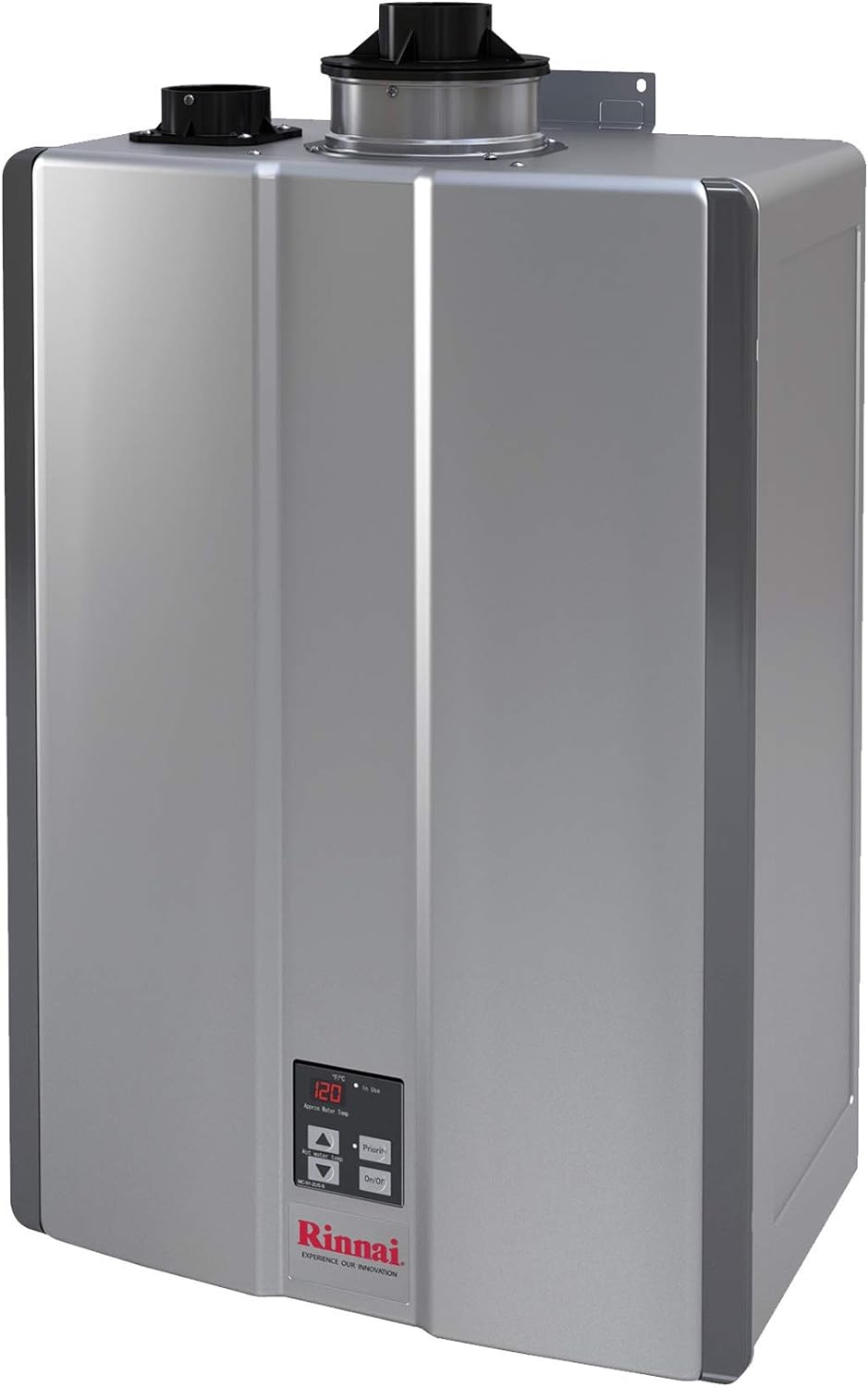
1. Rinnai RU199iN Ultra Series - Best Overall Gas Condensing
- Flow Rate: 11.1 GPM (natural gas)
- BTU Input: 15,000-199,000 BTU/hr
- Efficiency: 0.96 UEF
- Venting: PVC (3" or 4") - condensing
- Warranty: 12-yr HX / 5-yr parts / 1-yr labor
- Price Range: $1,000-$1,300
The RU199iN sits at the top of Rinnai's residential condensing line for a reason. At 11.1 GPM on natural gas, it handles two simultaneous showers plus a dishwasher without dropping outlet temperature. The condensing design wraps a secondary heat exchanger around the exhaust flue, extracting heat that non-condensing units waste - that's where the 0.96 UEF rating comes from. On average family usage, expect roughly $180/year in gas savings vs. a standard 0.67 UEF tank heater.
What distinguishes Rinnai from the competition isn't just specs - it's infrastructure. Rinnai has sold in the U.S. since 1974. Their parts are available at most plumbing supply houses. Their dealer network covers every major metro and most rural markets. When a condensate neutralizer needs replacement at year 7, your HVAC tech will know what to do. That matters when you're betting on a 15-20 year product.
The RU199iN connects to Rinnai's Control-R Wi-Fi module (~$100 sold separately) for remote monitoring and diagnostics. Temperature adjustable from 98°F to 140°F. Modulates down to 11,000 BTU on low demand for minimal waste.
Pros
- Deepest service and parts network of any brand in North America
- Consistent real-world GPM that matches spec sheet claims
- Proven 15+ year track record in residential installations
- Wi-Fi module available for remote monitoring and diagnostics
- Modulates down to 11,000 BTU for minimal waste on low demand
Cons
- No integrated recirculation pump - cold water sandwich not solved natively
- Wi-Fi module is an extra ~$100, not included
- 12-year HX warranty is shorter than Navien's 15-year and Rinnai's own RU180iN
Verdict
The Rinnai RU199iN is the default right answer for large homes with gas service in moderate to cold climates. It isn't flashy. It doesn't have Navien's built-in recirculation. But it has the best service infrastructure in the industry and a 50-year company track record. If you're replacing a tank heater and want to make the right call once and not think about it again for 15 years, this is your unit.
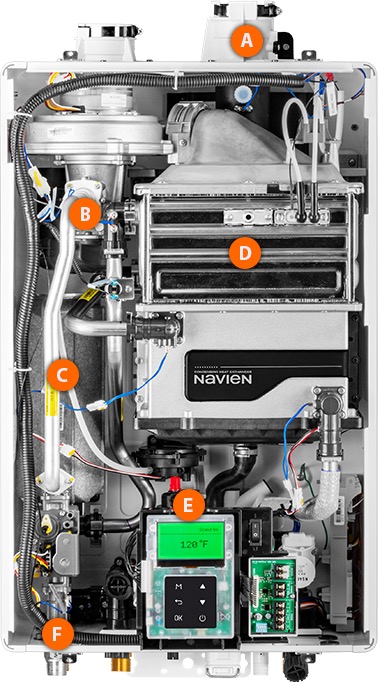
2. Navien NPE-240A2 - Best Premium with Built-In Recirculation
- Flow Rate: 11.2 GPM (natural gas)
- BTU Input: 15,000-199,900 BTU/hr
- Efficiency: 0.97 UEF
- Buffer Tank: 0.8 gal integrated
- Recirculation: Built-in ComfortFlow pump
- Warranty: 15-yr HX / 5-yr parts / 1-yr labor
- Price Range: $1,100-$1,400
The NPE-240A2 is the most thoughtfully engineered residential tankless unit available in 2026. Navien built two things into this unit that competitors make you buy as add-ons: a built-in recirculation pump and a 0.8-gallon buffer tank. Together they form the ComfortFlow system, which eliminates cold water sandwich - the brief slug of cold water between hot water bursts when the unit fires up after a brief rest.
At 0.97 UEF, the NPE-240A2 leads the gas condensing category on efficiency. The 15-year heat exchanger warranty is the longest in the gas tankless segment alongside the Rinnai RU180iN and Takagi T-H3. Built-in NaviLink Wi-Fi control is included - no separate module needed.
The trade-off: Navien's service network, while growing, is narrower than Rinnai's. In major metro areas, you'll find plenty of Navien-certified technicians. In rural markets, you may wait longer for a qualified service call. The A2 series (current generation) has addressed most of the reliability issues that plagued the earlier A1 series.
Pros
- Built-in ComfortFlow recirculation - no cold water sandwich
- Best-in-class 0.97 UEF efficiency
- 15-year heat exchanger warranty (industry-leading)
- NaviLink Wi-Fi built in - no extra module needed
- Stainless steel heat exchanger resists corrosion
Cons
- Smaller service network than Rinnai outside major metros
- Verify you're buying A2 series - older A1 had reliability issues
- $100-$200 premium over comparable Rinnai units
Verdict
If you're in a major metro area and want the most technically advanced condensing gas unit available, the Navien NPE-240A2 is the answer. The integrated recirculation and buffer tank solve a real usability problem that no other unit addresses natively. The premium over a Rinnai is $100-$200 - a rounding error on a 15-20 year investment.
3. Rinnai RU180iN SENSEI - Best Mid-Range for 2-3 Bathroom Homes
- Flow Rate: 10 GPM (natural gas)
- BTU Input: 15,000-180,000 BTU/hr
- Efficiency: 0.93 UEF
- Venting: PVC (3" or 4") - condensing
- Recirculation: Compatible (pump sold separately)
- Warranty: 15-yr HX / 5-yr labor / 1-yr parts
- Price Range: $900-$1,150
The RU180iN is the sweet spot of Rinnai's SENSEI line. At 10 GPM and 180,000 BTU, it handles 2-3 simultaneous hot water demands without breaking a sweat. This is the unit we recommend for the average American home with 2-3 bathrooms - it delivers 90% of the RU199iN's performance at a $100-$200 lower price point.
The standout spec here is the warranty: Rinnai gives the RU180iN a 15-year heat exchanger warranty - three years longer than the higher-end RU199iN. That's unusual. It signals that Rinnai has high confidence in this unit's longevity. The SENSEI platform also includes ThermaCirc360 recirculation compatibility - you'll need to buy a pump separately (~$200-$350), but the unit is pre-plumbed for it.
At 0.93 UEF, the RU180iN is slightly less efficient than the RU199iN (0.96) and Navien (0.97), but the real-world difference is $20-$40/year on a typical gas bill. The $100-$200 saved on purchase price offsets multiple years of that efficiency gap.
Pros
- 15-year heat exchanger warranty - longer than the RU199iN
- 10 GPM handles 2-3 bathrooms comfortably
- $100-$200 less than RU199iN with similar real-world performance
- Rinnai's full service network and parts availability
- ThermaCirc360 recirculation-ready (pump sold separately)
Cons
- 0.93 UEF - slightly lower efficiency than top-tier condensing units
- May be undersized for 4+ bathroom homes in cold climates
- No built-in recirculation pump (add ~$200-$350 for external)
Verdict
The Rinnai RU180iN is our "if you only read one review" pick. For the majority of American homes - 2-3 bathrooms, moderate to cold climate, existing gas service - this unit hits the performance/price sweet spot. The 15-year heat exchanger warranty is the longest Rinnai offers on any residential unit, and the $900-$1,150 price point makes it the most accessible condensing option from the industry's most trusted brand.
4. Takagi T-H3-DV-N - Best for Heavy-Duty Residential & Light Commercial
- Flow Rate: 10 GPM (natural gas)
- BTU Input: 19,500-199,000 BTU/hr
- Efficiency: 0.95 UEF
- Heat Exchanger: HRS35 copper alloy
- Multi-Unit: Easy-link up to 4 / multi-link up to 20
- Venting: PVC (3" or 4") - condensing
- Warranty: 15-yr HX / 5-yr parts
- Ultra-Low NOx: Yes - compliant
- Price Range: $1,100-$1,400
The Takagi T-H3-DV-N occupies a unique space: it's a residential-rated unit with commercial-grade internals. The HRS35 copper alloy heat exchanger is specifically chosen for durability under heavy usage patterns - Takagi markets this unit for small restaurants, beauty salons, and laundromats in addition to large homes. If your household runs hot water like a small business (think: large family, multiple teenagers, frequent guests), the T-H3 is built for that punishment.
The easy-link system allows cascading up to 4 units, and multi-link goes to 20 - obviously overkill for residential, but it means if you ever need to add capacity, you can parallel a second unit without replacing the first. At 10 GPM and 199K BTU, the base specs match the Rinnai RU199iN class. The 0.95 UEF puts it in the same condensing efficiency tier.
Takagi is a Japanese manufacturer with a strong following among commercial plumbing contractors. Their residential market presence is smaller than Rinnai or Navien, which means fewer local dealers and potentially longer waits for service calls. Parts availability is good through plumbing supply houses, but your average Home Depot doesn't stock Takagi on the shelf.
Pros
- HRS35 copper alloy heat exchanger - built for heavy-duty usage
- Easy-link up to 4 units for scalable capacity
- 15-year heat exchanger warranty
- Ultra-low NOx compliant (important in CA, TX, and other regulated states)
- Strong reputation among commercial plumbing contractors
Cons
- Smaller residential dealer network than Rinnai or Navien
- Not typically stocked at big-box retailers
- Price premium over Rinnai RU180iN without clear residential advantage
Verdict
The Takagi T-H3-DV-N is the right choice for homeowners who want commercial-grade durability in a residential package. If you have a large family that hammers hot water, or if you're a contractor fitting out a small business, the HRS35 heat exchanger and multi-unit linking capability are genuine advantages. For typical residential use, the Rinnai RU180iN or RU199iN are easier to service and similarly priced.
5. Noritz EZ111-DV - Best Steady-State Performance & Multi-Unit Linking
- Flow Rate: 11.1 GPM (natural gas)
- BTU Input: 12,800-199,900 BTU/hr
- Efficiency: 0.96 UEF
- Heat Exchanger: Dual stainless steel
- Steady BTU Mode: Yes
- Multi-Unit: Common vent up to 2 units (built-in non-return valve)
- Venting: PVC (3" or 4") - condensing
- Warranty: 12-yr HX / 5-yr parts
- Price Range: $1,050-$1,300
The Noritz EZ111-DV is the dark horse on this list. While Rinnai and Navien dominate mindshare, Noritz has been quietly building tankless water heaters in Japan since 1951 - longer than either competitor. The EZ111 brings dual stainless steel heat exchangers (most competitors use a single exchanger) and a unique Steady BTU mode that maintains consistent burner output during low-flow, low-temperature-rise scenarios where other units struggle with temperature fluctuations.
At 11.1 GPM and 0.96 UEF, the raw specs match the Rinnai RU199iN. The built-in non-return valve allows common venting of two EZ111 units - a cost-saving feature if you're installing a pair for a large home, since you only need one vent penetration through the roof or wall instead of two.
Noritz's U.S. service network has improved significantly in recent years, though it still trails Rinnai in rural coverage. The dual stainless steel heat exchanger design is a legitimate durability advantage over single-exchanger copper designs - stainless resists the acidic condensate that condensing units produce better than copper does over time.
Pros
- Dual stainless steel heat exchangers - superior condensate resistance
- Steady BTU mode eliminates temperature fluctuations at low flow
- Built-in non-return valve for common venting of 2 units
- 11.1 GPM matches top-tier competitors
- 0.96 UEF - competitive efficiency
Cons
- Lower brand recognition than Rinnai or Navien in the U.S.
- 12-year HX warranty - shorter than Navien's 15-year and some Rinnai models
- Service network improving but still thinner than Rinnai
Verdict
The Noritz EZ111-DV deserves more attention than it gets. The dual stainless steel heat exchangers are a genuine engineering advantage for long-term durability, and the Steady BTU mode solves a real annoyance (temperature swings at low flow) that most competitors ignore. If you're a homeowner who values under-the-radar quality over brand cachet, the EZ111 is a smart pick - especially if you're installing two units and can take advantage of common venting.
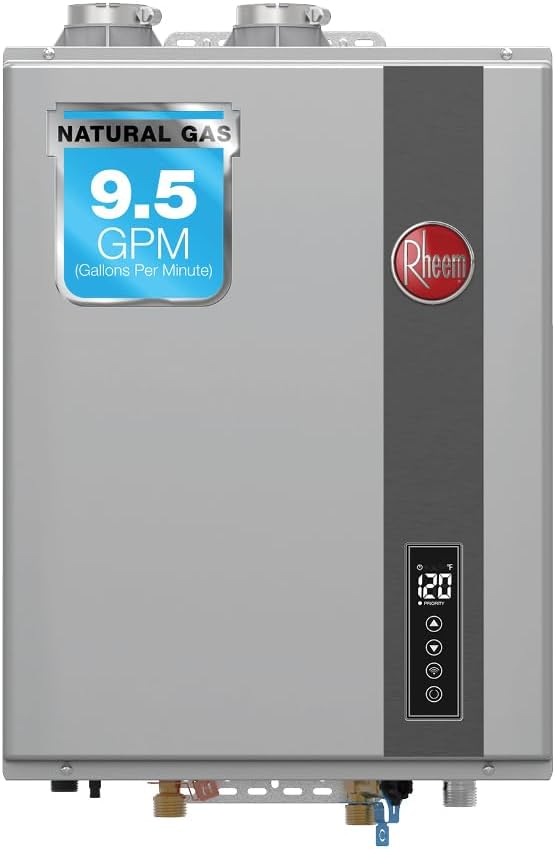
6. Rheem RTGH-95DVLN - Best Budget Gas (Non-Condensing)
- Flow Rate: 9.5 GPM (natural gas)
- BTU Input: 11,000-180,000 BTU/hr
- Efficiency: 0.82 UEF
- Venting: 4" stainless steel - non-condensing
- Warranty: 12-yr HX / 5-yr parts / 1-yr labor
- Price Range: $950-$1,100
The RTGH-95DVLN is a non-condensing gas unit - meaning it doesn't capture secondary heat from exhaust gases. The 0.82 UEF vs. 0.96 for condensing units translates to roughly $1,500-$2,000 in higher operating costs over 15 years at average gas prices. So why consider it?
Installation cost. Non-condensing units vent through stainless steel pipe that goes through a chimney or dedicated flue. If your home already has a compatible chimney flue from a previous gas appliance, installation can be $500-$1,000 cheaper than a condensing unit that requires new PVC runs through walls and ceilings. That upfront savings partially offsets the efficiency gap.
Rheem has strong distribution - the RTGH-95DVLN is one of the most commonly stocked units at Home Depot and Lowe's nationwide. That availability translates to faster parts and service. The 9.5 GPM handles a 3-bedroom, 2-bathroom home in moderate climates without drama.
Pros
- Wide availability at Home Depot, Lowe's, and local supply
- Lower installation cost when existing chimney flue is compatible
- Strong 12-year heat exchanger warranty
- Simpler maintenance - no condensate neutralizer needed
Cons
- 0.82 UEF is significantly less efficient than condensing alternatives
- Stainless steel venting is expensive if you don't have an existing flue
- No Wi-Fi connectivity on this model
Verdict
The Rheem RTGH-95DVLN makes sense in one specific scenario: you have an existing compatible chimney flue and want to minimize total installed cost. Run the math on your situation - in many cases, the condensing upgrade (Rinnai RU180iN) pays back the difference within 3-4 years through lower gas bills. But if your plumber quotes $800+ more for condensing venting, the Rheem is a legitimate value play.
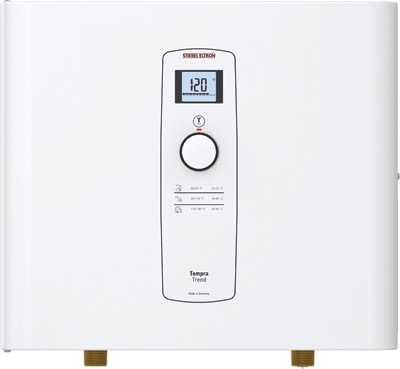
7. Stiebel Eltron Tempra 36 Plus - Best Whole-House Electric
- Flow Rate: 7.03 GPM at 50°F rise
- Power: 36 kW
- Voltage / Amperage: 240V / 150A (2× 60A double-pole breakers)
- Advanced Flow Control: Yes
- Dimensions: 17.75" × 16.75" × 5.5"
- Warranty: 7-yr unit / 3-yr parts
- Country of Origin: Germany
- Price Range: $700-$900
Stiebel Eltron has manufactured electric water heaters in Germany since 1924. The Tempra 36 Plus is their flagship whole-house unit, and the engineering details show. The Advanced Flow Control system is particularly smart: if incoming water temperature drops and the unit can't heat to your set temperature at the current flow rate, it restricts flow rather than delivering cold water. That prevents the unpleasant surprise of sudden temperature swings that cheaper electric units allow.
At 36 kW, the Tempra 36 Plus is the most powerful electric tankless that makes practical sense for whole-house use. You get 7.03 GPM at a 50°F temperature rise - covering one shower and a sink simultaneously in most climates. In warm climates (groundwater 65-70°F), two simultaneous showers is comfortable. In cold northern climates (groundwater 40-45°F), you're effectively limited to one shower at a time. That's the fundamental constraint of all electric tankless for whole-house use.
Electrical requirements are substantial: 240V at 150A, requiring two 60A double-pole breakers. Most 200A panels accommodate this without an upgrade. Older 100A-service homes need a panel upgrade first ($1,500-$3,000). Factor that into your total cost comparison with gas.
Pros
- German-engineered precision - built to a higher tolerance than competitors
- Advanced Flow Control prevents cold water delivery on temp drops
- 7-year unit warranty - longest in electric tankless category
- Silent operation - no burner, no exhaust, no venting needed
- Compact wall-mount design fits anywhere
Cons
- 150A requirement may need panel upgrade in older homes
- Lower GPM than gas in cold climates - limited simultaneous demand
- Higher electricity operating cost than gas in most U.S. markets
Verdict
For homeowners without gas service, or in condos where gas venting isn't possible, the Stiebel Eltron Tempra 36 Plus is the right answer. Nothing else in the electric category matches its build quality, Advanced Flow Control, or 7-year warranty. If gas is available, run the economics - gas condensing wins on operating cost in most U.S. markets. But if electric is your only option, this is the unit.
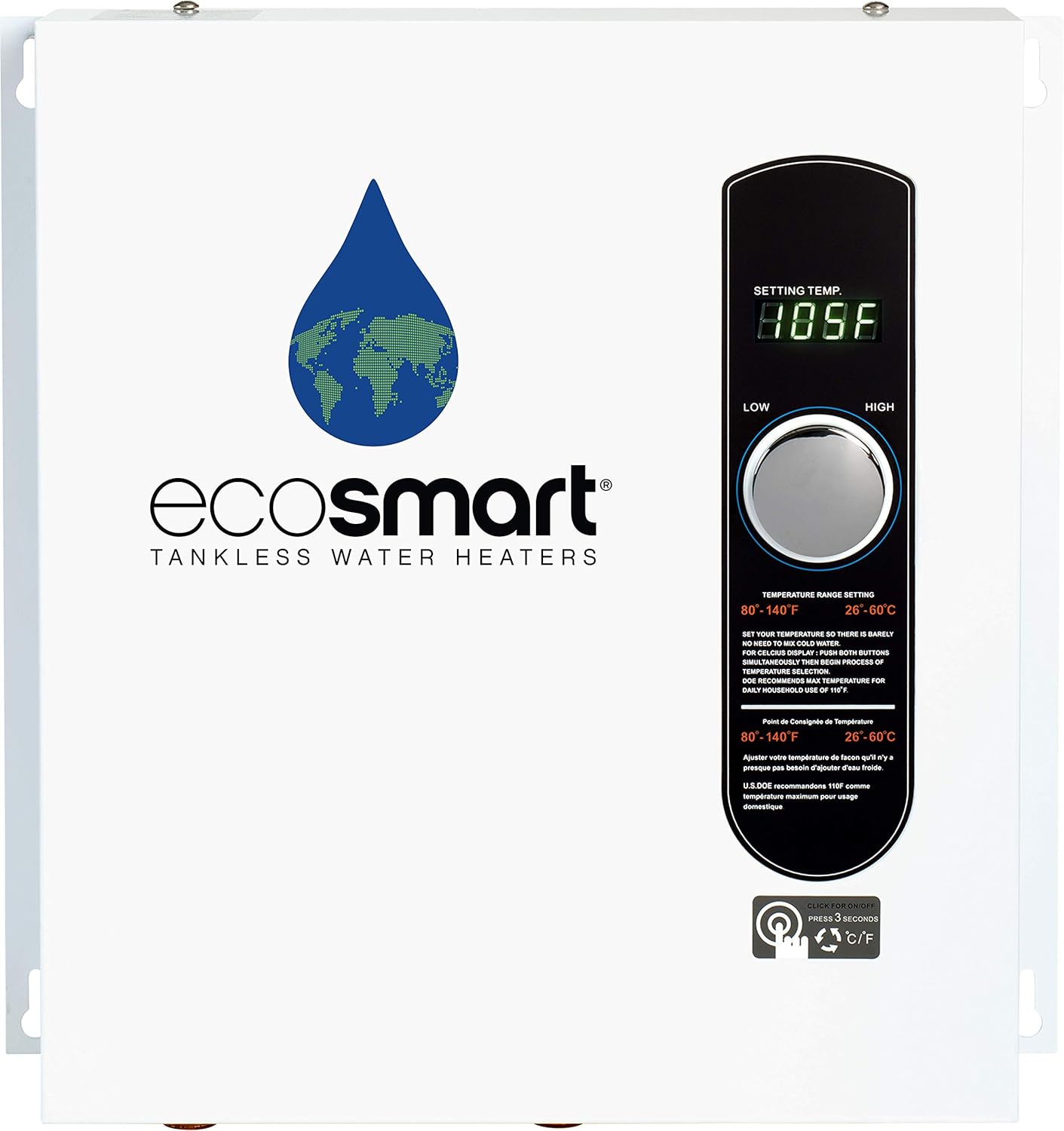
8. EcoSmart ECO 27 - Best Budget Electric for Warm Climates
- Flow Rate: 3.0-6.5 GPM (climate-dependent)
- Power: 27 kW
- Voltage / Amperage: 240V / 112.5A (3× 40A double-pole breakers)
- Self-Modulating: Yes
- Warranty: Lifetime unit warranty
- Country of Origin: USA
- Price Range: $290-$390
At $290-$390, the EcoSmart ECO 27 is the entry point for whole-house electric tankless. The lifetime warranty is a real differentiator - no other unit on this list backs itself that way. EcoSmart's self-modulating technology adjusts power draw based on incoming water temperature, reducing your electric bill in spring and fall when groundwater is warmer.
The honest limitation: 27 kW isn't enough for whole-house demand in cold climates. In Florida, Texas, or Gulf Coast states where groundwater stays above 65-70°F year-round, the ECO 27 handles 2 simultaneous fixtures adequately. In northern states, GPM drops significantly in January and February. This isn't a product flaw - it's physics. 27 kW can only heat so many gallons per minute through a 70°F rise.
Pros
- Lifetime warranty - best coverage in the category by far
- Self-modulating technology reduces energy use in mild weather
- $290-$390 price point - fraction of competitors
- US-manufactured, domestic parts availability
Cons
- 27 kW limits GPM in cold climates - a real problem in northern states
- Requires three 40A breakers - unusual configuration
- Customer service has mixed reviews for warranty claims
Verdict
The EcoSmart ECO 27 is the right choice if you're in a warm climate (groundwater stays above 60°F in winter), have a 1-2 bathroom home, and want the lowest entry cost for electric tankless. The lifetime warranty is genuinely unmatched. If you're in a northern state or have more than 2 bathrooms, step up to the Stiebel Eltron Tempra 36 Plus - the extra $400-$500 is worth the cold-weather GPM difference.
Buying Guide: How to Choose the Right Tankless Water Heater
Step 1: GPM Sizing - The Number That Matters Most
GPM (gallons per minute) is the most important spec. Buy too little and you'll get temperature drops when two fixtures run at once. Buy too much and you're paying for wasted capacity and a more complex installation.
Inventory your peak simultaneous demand: a typical shower uses 1.5-2.5 GPM. A dishwasher uses ~1 GPM. A kitchen faucet runs 1.5-2 GPM. Add up the fixtures you'd realistically run at the same time during peak morning hours.
- 1-2 bathrooms, 2-3 people, moderate climate: 6-8 GPM
- 2-3 bathrooms, 3-4 people, moderate climate: 8-10 GPM
- 3+ bathrooms, 4+ people, or cold climate: 10-11 GPM
Cold climate adjustment: GPM ratings are published at a specific temperature rise. In January in Minnesota, your inlet temperature might be 40°F. To reach 110°F output requires a 70°F rise, which cuts rated GPM roughly in half. Size up 20-30% if you're in a cold climate.
Step 2: Gas vs. Electric
Choose gas if: You have natural gas service, you're in a cold climate, you have more than 2 bathrooms, or you want the lowest long-term operating cost.
Choose electric if: You have no gas service, you live in a condo with venting restrictions, you're in a warm climate with limited simultaneous demand, or you want the simplest installation.
Operating cost comparison: most U.S. markets charge less per BTU for natural gas than electricity. Average annual water heating cost: $250-$400 with gas condensing vs. $450-$700 with electric. Over 15 years, that's meaningful - but offset by higher gas installation costs.
Step 3: Condensing vs. Non-Condensing (Gas Units)
Condensing (Rinnai RU199iN, RU180iN, Navien NPE-240A2, Takagi T-H3, Noritz EZ111): Extract heat from exhaust gases for 0.93-0.97 UEF. Vent through PVC at low temperatures. Produce acidic condensate requiring a neutralizer. Cost $100-$200 more than non-condensing.
Non-condensing (Rheem RTGH-95DVLN): Exhaust hot gases through stainless steel or Category III vent. Achieve 0.80-0.85 UEF. No condensate. Work well with existing compatible flues.
For new installations, condensing is almost always the better long-term investment. The efficiency advantage pays back the premium within 1-2 years at average gas prices.
Step 4: Venting & Gas Line Capacity
Condensing units vent through cheap PVC; non-condensing requires expensive stainless steel. A high-capacity gas tankless unit pulls 180,000-199,000 BTU/hr - 4× what a standard tank uses. Your gas line may need to be upsized ($300-$800). Get quotes for both scenarios before deciding.
Step 5: Real Installation Cost Breakdown
- Unit: $900-$1,400 (gas condensing) / $290-$900 (electric)
- Labor: $400-$900 (gas) / $300-$600 (electric)
- Venting: $150-$400 (PVC condensing) / $0 (electric)
- Gas line upgrade: $300-$800 (if needed)
- Electrical panel upgrade: $1,500-$3,000 (if needed for electric)
- Permits: $100-$300
- Total range: $2,500-$5,500 (gas) / $600-$4,500 (electric)
Frequently Asked Questions
What size tankless water heater do I need for a 3-bedroom house?
A 3-bedroom house with 2 bathrooms typically needs 7-9 GPM in moderate climates (groundwater 55-65°F). In cold climates or with more than 2 simultaneous hot water demands, step up to 9-10 GPM. The Rinnai RU180iN (10 GPM) is our default recommendation for this scenario.
How much does it cost to install a tankless water heater in 2026?
Total installed cost: $2,500-$5,500 for gas condensing; $600-$4,500 for electric (wildcard: panel upgrades). The unit is 30-45% of total cost; labor, venting, and infrastructure make up the rest. Always get 2-3 contractor quotes.
Gas or electric - which is better?
Gas wins on flow rate (9-11 GPM vs. 3-7 GPM electric) and cold-climate performance. Electric wins on installation simplicity, lower unit cost, and zero CO risk. If you have gas service and 2+ bathrooms, gas condensing is the better long-term value. Use our Decision Tree for a personalized recommendation.
What is the cold water sandwich?
A brief slug of cold water between hot bursts when the unit fires up after a short rest. The Navien NPE-240A2 solves this with a built-in recirculation pump and buffer tank. Other units require an external pump add-on ($200-$500 installed).
How long do tankless water heaters last?
15-20 years with proper maintenance (annual descaling, condensate neutralizer replacement). That's roughly 2× the lifespan of a traditional tank heater. The heat exchanger is the limiting component. Warranty terms (12-15 years) are a realistic guide to expected lifespan.
Do tankless water heaters work in cold climates?
Yes - but size for winter performance, not summer. A unit rated 10 GPM at 35°F rise delivers only 5-6 GPM at a 70°F rise (which is what you need when January groundwater is 40°F). Size up 20-30%. Both Rinnai and Navien publish detailed GPM charts across multiple temperature scenarios.
Can I install a tankless water heater myself?
Gas: No - requires licensed plumber and HVAC tech in most jurisdictions. Carbon monoxide risk makes this non-negotiable. Electric: Possible if you're comfortable with electrical work, but permits are still required in most areas. Budget for professional installation either way.
What BTU rating do I need?
Use our BTU/GPM Calculator above. The formula: BTU = GPM × Temperature Rise × 8.33 × 60. For a family of 4 needing 8 GPM at a 50°F rise, you need ~200,000 BTU. Most residential gas units max at 180,000-199,900 BTU.
Sources and Methodology
This guide is built from manufacturer specification sheets, ENERGY STAR certification data, DOE Uniform Energy Factor (UEF) test reports, 4,800+ verified owner reviews on Amazon and Home Depot, contractor forums, and HVAC professional input. Prices reflect March 2026 retailer pricing and will fluctuate - always verify before purchasing.
We do not accept manufacturer payments, free products, or sponsored placements. Rankings are determined by research data, not commercial relationships. See our About page for full methodology details and our Affiliate Disclosure for commission information.